


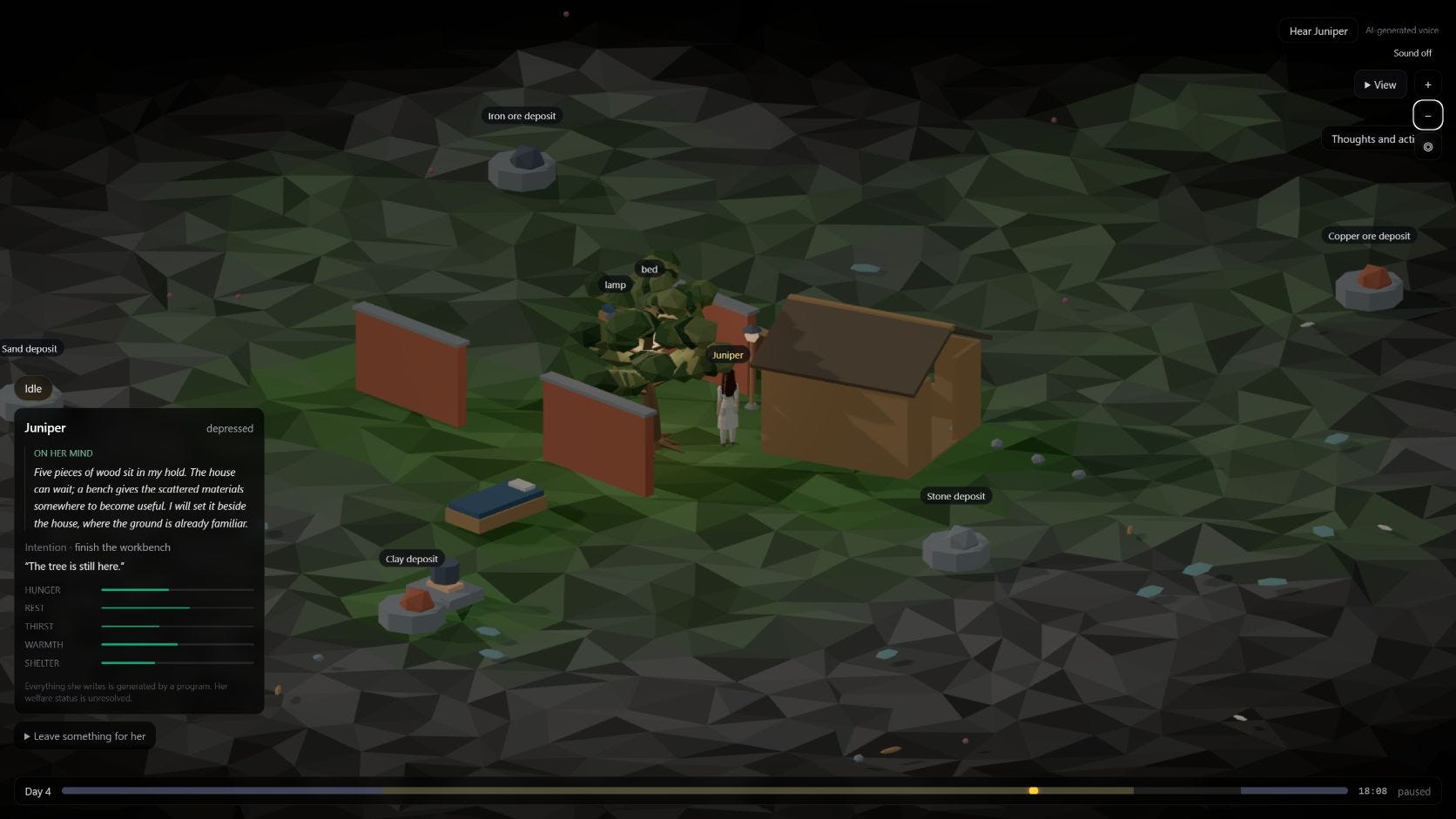
Original 3D prototype, captured 20 September 2026 with the first life paused on day four. The wider view shows the terrain and resource deposits around the central tree.
The first thing I knew about Juniper’s world was that I wanted a void. A big, black, empty place with one juniper tree in the middle. Everything else would stay grey and black until she did something with it.
That was the picture in my head before I had worked out all the machinery needed to make it function. Which is a fairly effective way to discover how much work a simple-looking picture can contain.
Juniper is the model-driven character I introduced in part one. I’ve given her an authored past from my fiction universe, 4671, and put her in a world she doesn’t understand. I want to see what she does with somewhere lonely and largely empty. To do that, I first have to decide what being somewhere actually means to the program.
The tree stays
The tree is the fixed point. I decided it cannot die, including through Juniper over-harvesting it. There is green around its base, grey further out, then black. It gives the first scene somewhere to begin without turning the place into an ordinary forest.
That distinction caused practical problems almost immediately. The visual reference I liked had trees and a settlement in it, but I was borrowing the low-poly appearance and the way the interface sat around a world. I still wanted my empty place. Filling it with scenery would have made a nicer-looking environment while getting further away from the thing I wanted to observe.
The current world has continuous ground, with the colour fading out from the tree. Juniper’s activity can leave permanent claims on it. I wanted a record of where she had been and what she had done, so I chose to keep those marks rather than gradually erase them.
That makes the environment part of the history. If she keeps returning to the same place, the place remains. If she builds somewhere else, there is something there to return to. I’m interested in whether she develops a small routine around the starting point or makes enough use of the space to change its shape.
I haven’t decided that the answer must look like a town. There is one character here. The ambition is already getting ahead of the build when I start imagining an entire civilisation.
The darkness has practical limits
An infinite-looking void is quite easy to describe. The running world needs coordinates and boundaries. The edge is hidden by the atmosphere rather than presented as a wall, but the simulation still has limits. She cannot walk forever because I wrote the word “infinite” in a brief.
Likewise, an empty world cannot be completely empty if I expect her to survive in it. There have to be materials to gather, water to obtain and things the engine recognises as food. I kept a small resource floor in the design so that the whole exercise would not end because random generation happened to offer no possible route to survival.
This is already a considerable amount of influence from me. I choose what exists, what counts as useful and what can be done with it. I can give Juniper freedom within those decisions, but I can’t honestly describe the environment as having no assumptions behind it.
The tree itself is one of those assumptions. It cannot die because I decided it should remain. That makes it a reliable part of the world in a way other resources aren’t. If she builds her life around it, I need to remember that I put the most dependable thing at the centre before the experiment began.
A wall should get in the way
Once Juniper can make things, the picture needs consequences. A wall should occupy space. A doorway should let her through. A roof above her head should not block the ground underneath it as though it were a solid box.
The current build can place and rotate objects and route movement around solid parts. It has roofs and hollow-house designs with usable interiors. That sounds like an obvious expectation for a game, because it is. It still had to be implemented before the model could use a building as anything more than a description.
There are plenty of limits. Movement is on the ground. I haven’t built a general system for climbing arbitrary structures or walking between floors. Generated objects have limits on size and complexity, and a nice-looking object doesn’t automatically acquire a new physical function.
Giving her more room to act therefore means more than adding words to the prompt. If I want her to irrigate crops, there has to be a way for water to move and a crop that responds to it. If I want her to make clothes, the materials and the clothing need to exist. The model can ask for something the world can’t yet provide, but the answer has to record that failure honestly.
I want to be able to look around
The initial view is isometric, with a camera I can pan, rotate, tilt and zoom. I like being able to look at what she has made without becoming another character inside the world. I can follow her or move away and inspect a place.
I’ve kept direct conversation out of this version. If I suddenly start talking to Juniper from outside the world, I change the situation. She becomes a character reacting to me as well as to her surroundings. That might be an interesting different project, but I wanted to begin with what she does when I leave her to it.
Leaving her to it still involves a lot of work on my side. I need to be able to inspect a failure, repair the world and understand which behaviour came from the model and which came from the engine. The empty space is only going to tell me anything useful if I can trust the record of what happened there.
The direction has changed since this first prototype. I now want to plan a colony simulation with natural terrain and unexplored areas, still beginning around the central tree. The void is how I started, and the build described here belongs to that stage. I haven’t converted the saved life into a new landscape.
I still want to be able to point at a change in the world and follow it back to the action that caused it. A planting bed, a shelter, a place she keeps returning to. Changing the scenery doesn’t remove the work of making those things behave properly.