


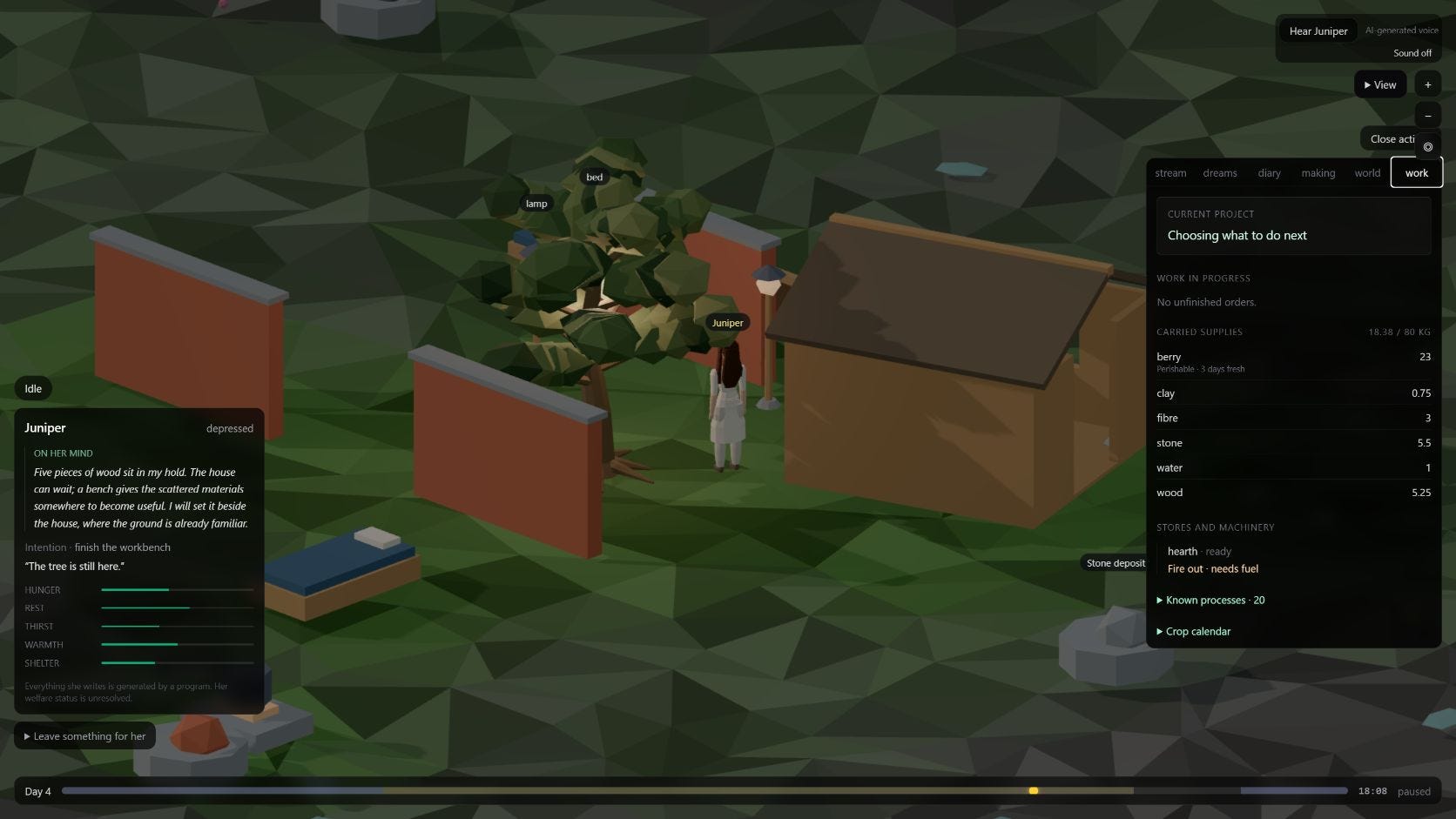
Work and inventory in the original prototype, captured 20 September 2026 at the paused day-four state. Food, carried materials and the hearth are recorded parts of the simulation.
This chapter follows the original September 2026 prototype. The later multiplayer settlement game is a separate stage of the project.
I wanted Juniper to have a reason to do things. If she can sit beneath a tree indefinitely and produce interesting sentences, I have made a fairly elaborate way to watch a chatbot.
So I gave her hunger, thirst, rest and warmth needs, along with simulated mood and motivation. She has to gather things, eat, drink, sleep and make enough use of the world to keep going. I was thinking about Maslow’s hierarchy when I started describing this, though what I’ve built is a game system, with rules I chose and numbers I can inspect.
That gives failing to find food a consequence in the game. Whether she feels hungry is another question.
Survival turns into a lot of small jobs
Once I wanted survival to involve making things, the basic needs spread through the rest of the game. Warmth can involve clothing, fuel and a hearth. Clothing can involve gathering fibre, processing it, weaving cloth and sewing. A meal can involve a crop, a season, water, work and somewhere to keep the result.
The later build has five crops with different uses, a set of manufacturing processes, finite mineral deposits, tools that wear, and food that ages. Irrigation consumes water. A pump or battery has to operate inside the resources available to it. Those are implemented rules; I still need to see how well Juniper uses them in a continuing life.
The rules need to hold up. If cancelling a job returns its materials twice, the character can accidentally become an industrial miracle. If moving food into storage resets its age, the world has invented refrigeration by changing the name of a container. I need the resources to remain consistent enough that a successful life means something.
This is also where my enthusiasm for games like Dwarf Fortress becomes a slightly expensive influence. Every useful interaction suggests three more systems. I have one character. I haven’t built populations, trade or a history-generating civilisation. Even so, the amount of simulation required to make her ordinary day interesting keeps increasing.
The engine helps her
A language model doesn’t need to decide every step of a journey or reconsider every moment of weaving. The current build can retain a destination or project and continue the small steps needed to complete it. Critical needs can interrupt a project, trigger recovery and then allow the original work to resume.
This helps her get things done. Some of that sensible behaviour comes from the engine, so the record needs to show which steps it handled.
For example, I programmed the survival system to help her get warm: obtain clothing or hearth materials, build and fuel a fire, recover. If that works, the model had help with the plan.
I am quite happy for ordinary code to do ordinary code’s job here. I already admitted in the opening article that an algorithm could perform plenty of these tasks more reliably than an LLM. What interests me is how the model’s choices work with a persistent world, and whether it can do anything useful with the room that remains.
Choosing the next job with Jev
For the island version, I want to test Jev between her larger plans and the engine that carries them out. Suppose she has timber in her pack, a shelter under construction and a growing need for food. The useful question is which job to do next. Walking each step of the route is already the engine’s responsibility.
Jev would receive the available choices and the relevant situation. It could prefer storing the timber before harvesting more, or interrupting construction to eat. The game would still calculate distances, find a route around walls and check what fits in her pack. TypeSafe itself recommends keeping arithmetic in code, which fits that division of work.
This is planned work, added on 21 September. The first comparison will let Jev suggest actions without controlling the saved world. I want to see whether it completes useful jobs with fewer delays and lower costs, while keeping OpenAI for Juniper’s conversation and more involved thinking. The ordinary NPCs remain algorithmic while I work out whether the extra model helps her.
Mood is another thing I made
I also wanted moods, desires and dreams. The program tracks values named after brain chemicals, changing them in response to what happens and whether her needs are met. It can represent sustained low mood and changes in motivation.
Those names are a way of organising the simulation. I have not made a biological model of a human brain, and a low number in that system is not a diagnosis. If the interface reports that Juniper is depressed, I need to read it as the state I’ve programmed, alongside whatever text the model generates about it.
The dream system uses things that happened during her day to assemble imagery she can respond to after sleep. For now, ordinary code does that without an extra paid model call. The model can react to it afterwards. The dream should be identified as a dream so it doesn’t silently become another event that supposedly happened while she was awake.
I like the idea that the character’s day leaves traces in more than her inventory. I also know how easily I could talk myself into a very human interpretation of a system I designed to resemble one. Keeping the mechanics visible helps me remember what I’m looking at.
Four days is enough to expose a problem
The first life reached its fourth simulated day during development. The record includes waking, drinking, making a coat, mining clay, starting and fuelling a hearth. Her warmth recovered enough for the recovery interruption to clear.
That happened alongside repeated gathering failures, sustained low mood and behaviour that still needs work. I want to see what happens after the immediate emergency has passed, when she has to maintain food and warmth while doing something else.
I’ve allowed the character to die in the design. If that happens, the old life is archived and the character resets without its lived memories, while the things left in the world remain. The tree stays too. I haven’t treated that design as evidence that a death has already happened.
The saved life is paused while I plan the move towards a colony simulation. Before adding a village, I want to see whether she can keep herself going after that first recovery. The farm needs to produce food, the food needs to be used, and Juniper needs to get back to whatever she was trying to do before she got cold.