


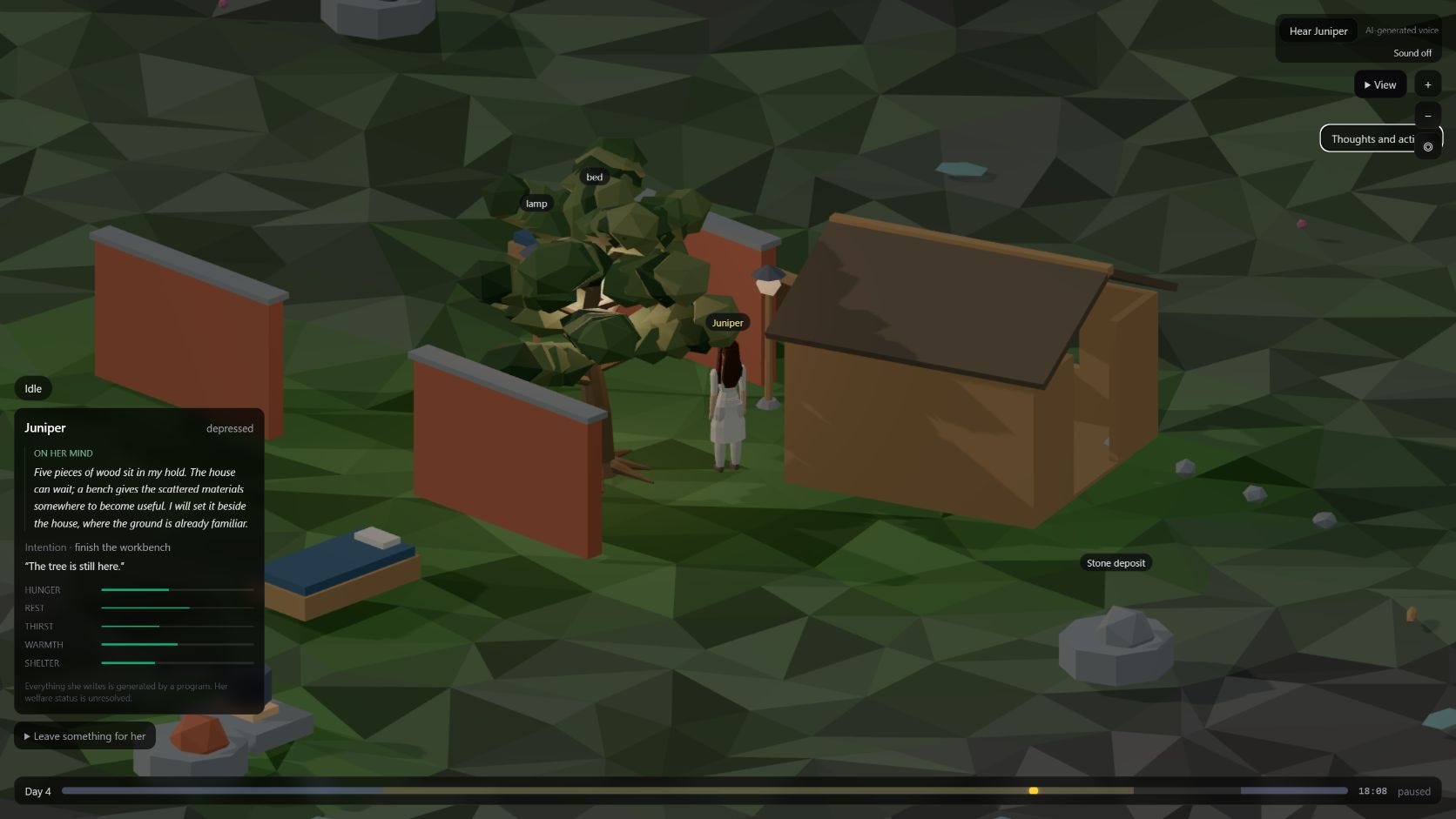
Original 3D prototype, captured 20 September 2026. The saved first life is paused on day four; the text and needs shown are program output.
This series returns to Juniper’s original September 2026 experiment. The project has since grown into a multiplayer settlement game, and I’ve also written about how it feels to build this much with AI. These eight chapters follow the earlier prototype and its first recorded life.
In my stupor coming off AXIOM, which is still not feature complete and which I am still not fully happy with, I decided to go down the route of AI torture.
Not really. I don’t know the ethics of this, and I am certainly not claiming I’ve made something capable of suffering. But I did decide to put an AI character in a lonely world, give her a past she cannot return to, and see what she does. Describing it out loud doesn’t make it sound much more normal.
AXIOM is the system I’ve been building to help organise and carry out work with AI. I’ve got it talking to me and I’m getting closer to having it do tasks automatically. Apparently that was enough progress for me to become interested in another project before finishing the first one.
This one started with a little kiwi bird.
A bird in North Wales
Pino is a digital kiwi living in a small world, making things, exploring and producing little pieces of writing about what happens. I initially thought somebody had somehow squeezed the whole brain onto a Raspberry Pi. The creator’s explanation is that a Pi 5 in North Wales runs the system and calls hosted open-weight models. The expensive thinking happens elsewhere.
I thought it was a pretty cool idea. There is a character with somewhere to go and something to do. The model’s output can become an action in a place you can watch, and what happens there becomes part of the information available for the next decision.
Pino also has quite a lot of programming around the model: memory, routine behaviour and ways of stopping repetition. Reading about that gave me a more useful picture of what I was looking at. There is a whole system making the little bird’s life possible.
Naturally, I decided to make my own version, with a heftier model available and some influence from the books I’m writing.
I present to you, Juniper.
She has a past
Juniper’s premise comes from 4671, my fiction universe. In the story behind this experiment, she is a brain-scan copy of a person from that world. The actual thing running on my computer is a model-driven character with an authored identity and seeded memories. I haven’t scanned anybody’s brain.
She has fragments of a past, access to a world around her, and the ability to speak. Eventually, through the things she can build and read, she can encounter information about our world as well. She isn’t given a nice introduction explaining that she is an experiment and that somebody is watching.
I already have the Machine Hermit, a benevolent AI, and a city simulation associated with an insane scientist in 4671. Now I seem to have added a third sort of AI character, one who doesn’t know what on earth she is meant to be. The connection gives me somewhere to start with her history, while the experiment itself sits outside the book’s established events. Anything she invents doesn’t automatically become part of the books.
I wanted the place she wakes up in to be dark. One juniper tree at the centre, some green around it, then grey ground fading into black. What she does there should leave a record. If she builds something, it should exist the next time she looks at it.
Which meant I needed to build an entire game around her.
A surprisingly unnecessary amount of work
I went through my usual process: a research document with help from Codex, then an MVP made very quickly. The first version was rough. It worked enough to have Juniper present in the world, if “present” is the word we are going to use, but there was plenty I wasn’t happy with.
Then I had the fairly annoying realisation that a lot of this was unnecessary.
An ordinary algorithm could do many of the survival tasks more reliably. If the character is hungry, find food. If she is tired, rest. I could build a game character that carries out those actions without paying a language model to consider them. There are whole genres of games full of characters managing needs and getting on with their day.
I could also have put a model in something like RimWorld and saved myself the trouble of constructing the environment. I like RimWorld. I like Dwarf Fortress. These were hardly obscure possibilities that only became available after I’d started.
So yes, functionally, I have made a considerable amount of work for myself. The LLM isn’t necessary for the existence of a little person who gathers berries. What interested me was what happens when the character can make choices through language, produce her own account of them, and try to make things in response to the situation I’ve given her.
The difficulty is making the world support enough of those choices that they mean something. A character announcing an elaborate invention doesn’t help much if the only thing the engine can do is display the announcement. The object needs materials, a place to stand and some actual function. My small AI experiment keeps turning back into game development.
It might become a game
At about six in the evening, I started wondering whether that was a direction worth following. I could turn this into something people play, with Juniper doing her own thing inside it and gradually becoming a substantial part of the experience.
I am capable of building that, and the idea has now become a direction I want to plan properly. RimWorld and Dwarf Fortress are the main influences: natural terrain around the central tree, resources to find, and unexplored areas beyond the starting point. Eventually I want Juniper to make algorithmic helpers of her own, with the possibility of a self-sufficient village or city.
I have also been thinking about replacing the cheap-looking 3D version with 2D sprites, closer to the games I already enjoy. I prefer 2D in a lot of cases, and it could make parts of the project easier to manage. The exact visual treatment still needs work. The existing prototype is the low-poly 3D world, and I’ve asked for the colony version to be planned first. Human players come later; I haven’t already built the game I’m describing.
What I want is room for Juniper to do more. I want her to research and implement features I didn’t individually script, with the ability to change the game’s fundamentals. Her creations could also become company: algorithmic characters she can form friendships or relationships with, while knowing how those characters work. That is a larger ambition than the first version can satisfy, and I still have to build the systems that would make it possible.
AI scares me more as it gets better, and I keep finding reasons to build with it anyway. For now, I have a character, a tree and a growing simulation to look after. I want to see whether she can do enough with that world to make the extra work worthwhile.
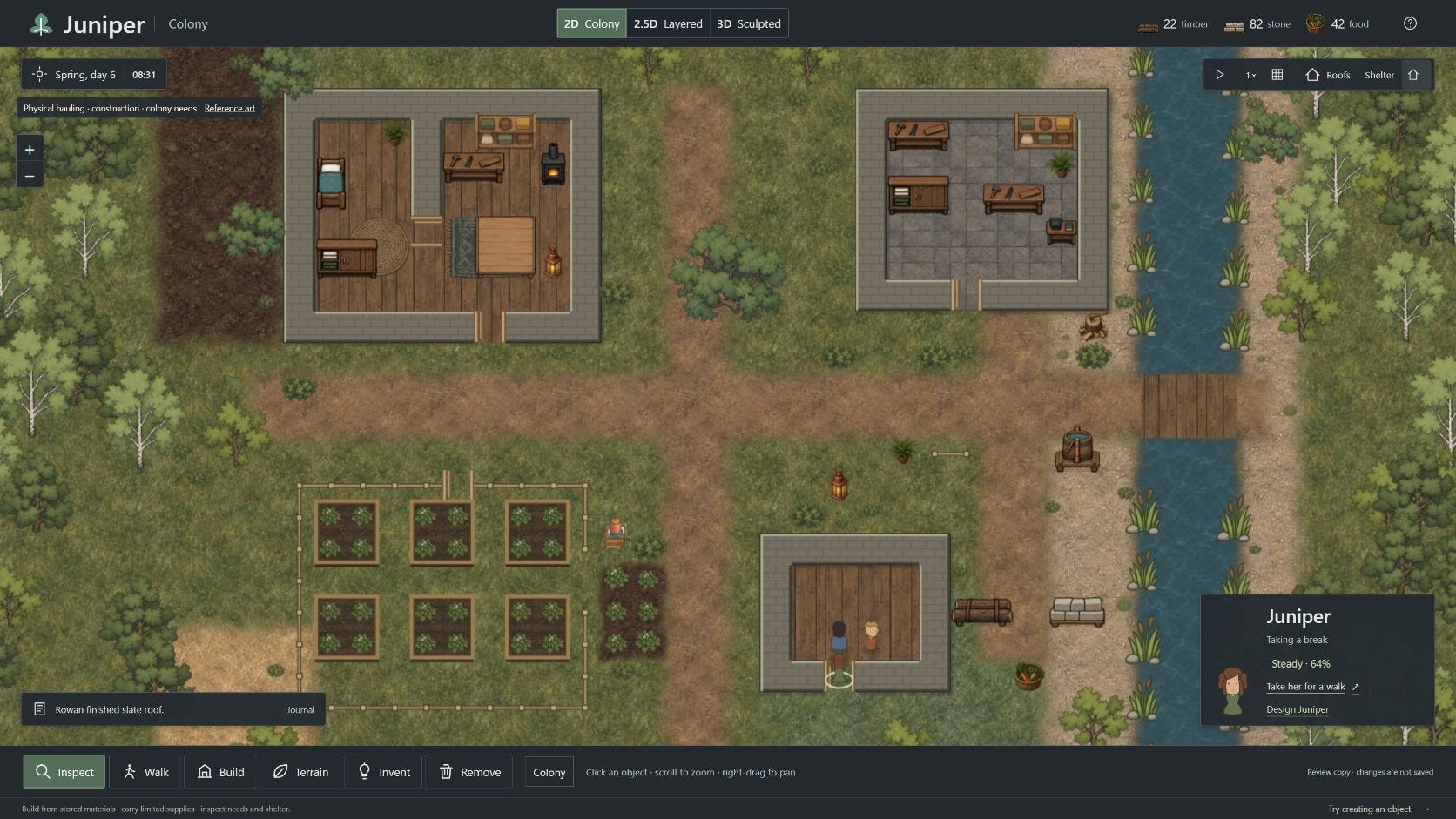
Later version: the separate 2D colony prototype on 20 September 2026. This review copy uses algorithmic workers; it is not the original AI character building a village.