



Photo: Rusty Industrial Wall with Soil · Bokeh by Tomas Heligr-Pyke
Once again, I build stuff because I can, not because I should.
On today’s episode, we are looking at Multiversal Sudoku. I had been wondering whether I could make a Sudoku that works across multiple boards at the same time. Apparently I could, and the first version took me an hour at most. Now I have another little game that needs somewhere to live.
I’d like to put it on Tomedia Newsroom, so the site starts having its own minigames along the lines of the New York Times. That is the intended home. The current version is a playable local experiment, and I still need to restyle it to fit.
How I have made Sudoku more annoying
Each universe is a normal nine-by-nine Sudoku board. Every row needs the numbers one through nine, once each. Every column needs the same, and so does every three-by-three box. The numbers already given to you stay put.
There are nine of these boards. So far, that sounds like I’ve made you do nine Sudokus, which would be a fairly unreasonable amount of homework to attach to a news website.
The extra rule links them together. Pick a cell position, say row four, column six. Find that exact position in all nine universes. Those nine cells must also contain one through nine, once each.
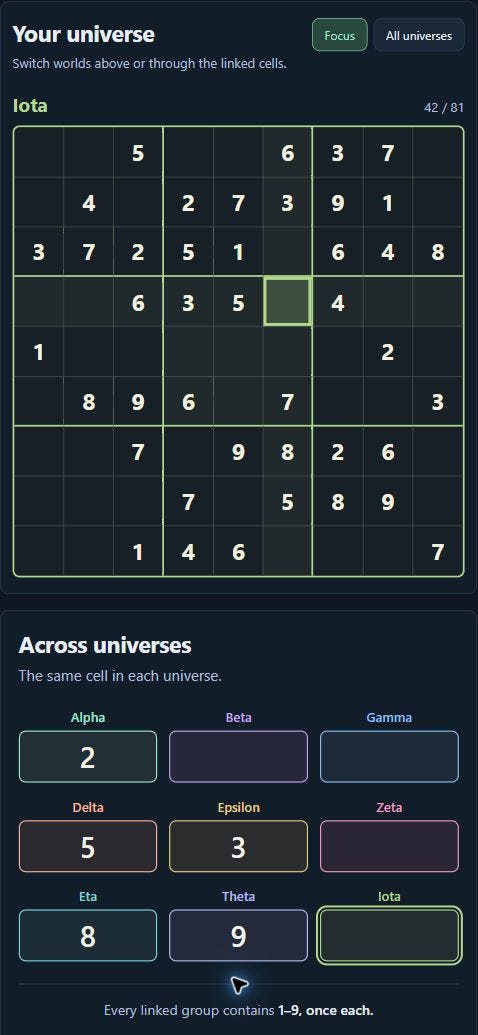
Current nine-board prototype, 7 October 2026. Row four, column six is selected in Iota; the panel below shows that same position in all nine universes. Those nine cells must contain 1–9 once each.
If you put a seven there in one universe, that position cannot contain seven in any of the other eight. The row, column and box around it still have their usual rules. Every cell has to satisfy all four constraints at the same time.
That is where it becomes a shared puzzle. A number might fit perfectly well into the board you’re looking at, but a matching position elsewhere can rule it out. Equally, something you work out on one board can help narrow down a choice on another.
You can follow a position across the universes and use what is already there to work out what is still possible. Then you come back to the local board, where its row, column and box may narrow it further. You keep moving between those pieces of information.
There are 729 cells altogether, with some filled in from the start. Finishing means completing all nine boards while keeping those matching positions valid too. You don’t get to finish one, congratulate yourself and ignore the other eight.
A certified masterpiece on display. I have managed to give a number puzzle cousins.
The interface gives you one large board to focus on, an overview for switching universes, and a panel showing the same selected position across all nine. Selecting a cell highlights its counterparts, which is fairly useful when the entire idea depends on remembering where you were looking.
It does actually work
There are three puzzles in the current version, along with pencil notes, candidate numbers, conflict highlighting and undo. There are hints that explain a deduction before you choose whether to apply it. Progress saves separately for each puzzle in the browser.
The puzzles have been checked for a single combined solution. They can also be completed through the implemented logical hints, including deductions across universes. The extra rule gives you deductions you couldn’t make from one board alone, so moving between them is part of solving it.
It is still a prototype. Having the rules and controls working gives me something to build around, but it doesn’t magically put the game into Newsroom or make the current styling fit the site.
I wanted a little game I would enjoy playing, and I now have one. The next job is making it comfortable to use and giving it a proper home in Newsroom so other people can actually play it. Nine Sudoku boards should be enough for now. I would quite like to finish this version before I find an excuse to add another dimension.