


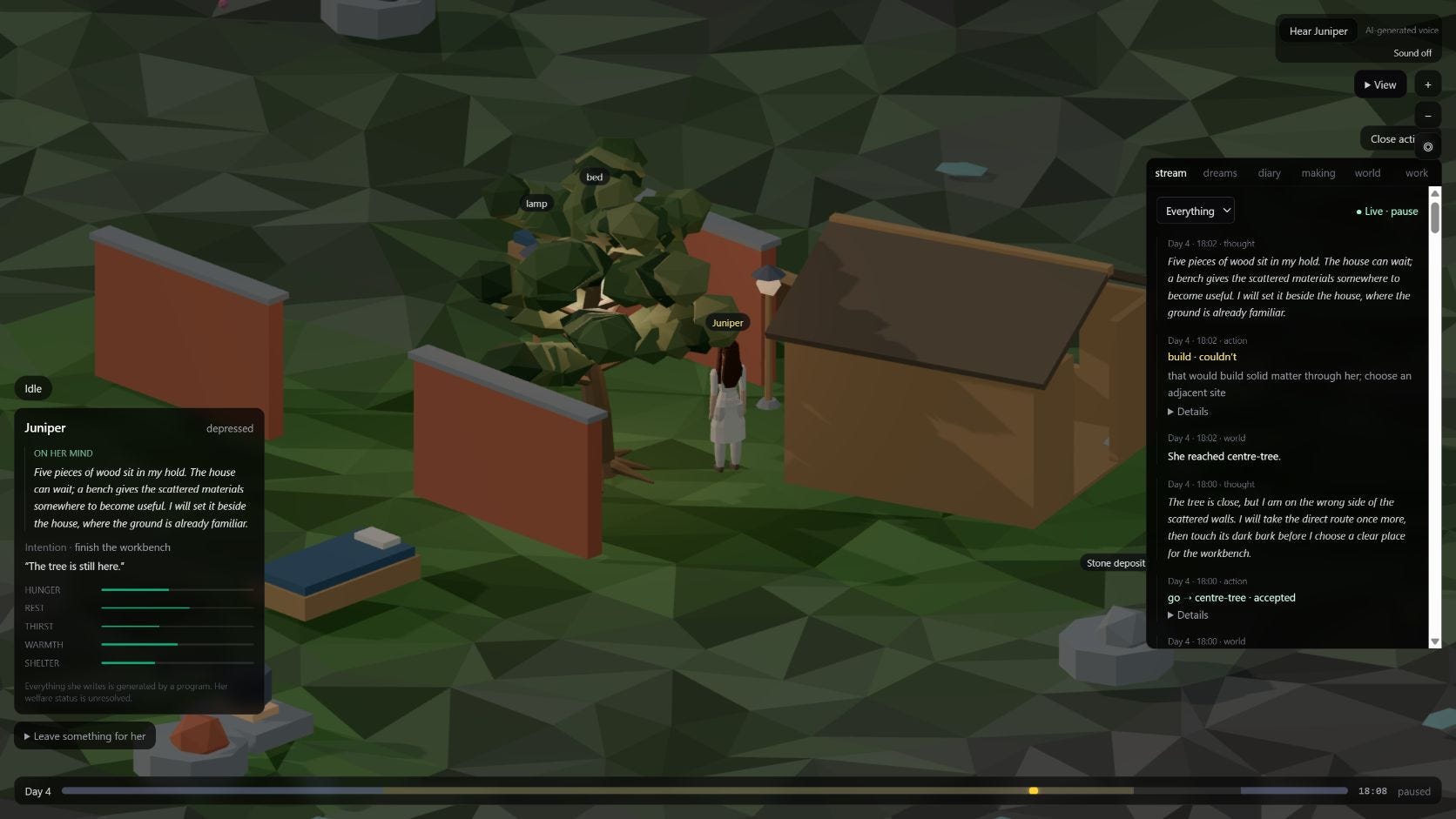
Original prototype activity stream, captured 20 September 2026 at the paused day-four state. Generated text sits beside the engine’s recorded action results, including a refused build.
This chapter follows the original September 2026 prototype. The later multiplayer settlement game is a separate stage of the project.
There is an obvious problem with dropping an AI into a world and asking what it discovers. The AI already knows things.
I can write that Juniper has never seen a computer, but the model behind her already knows what one is. I can give her a strange object and hope she works out how to use it, but she may already know that too.
So when I say I want Juniper to begin without knowledge of the outside world, I am describing the character’s starting position. I haven’t found a way to remove the outside world from the foundation model. That creates a fairly awkward limit for an experiment about discovery.
I can control what she is shown
The information I give her before each decision is up to me. What is nearby? What is she carrying? What happened when she last tried an action? What does the world report about her hunger, thirst, rest and warmth?
The model receives a description of the situation and a set of actions the engine understands. It produces a proposed action, which the engine then checks. If she asks to gather something out of reach, the request can fail. If she doesn’t have the material for a construction, a convincing explanation doesn’t provide it.
That at least gives her a place where knowledge has to become an action. Knowing what a wall is won’t put one in the world. There are materials to find, positions to choose and a construction process to complete.
I still have to be careful about what I call learning. A model correctly describing a thing on its first encounter may be using knowledge it brought with it. A successful action after a recorded failure gives me something more specific to inspect. I can look at what changed in the information and whether the next choice made better use of it.
Even then, picking something up once doesn’t tell me whether she can do it again, or use what she learned on another task.
A different model for ordinary decisions
On 21 September I added another direction to the plan. I want to try Jev, TypeSafe’s decision model, for the frequent choices that don’t need a paragraph of explanation. I think of it as a probability machine: give it the situation and some possible actions, and ask which fits. TypeSafe describes its answers as typed choices, scores and probabilities that software can use directly. Its introduction explains the distinction.
OpenAI would still handle Juniper’s direct reflections, conversation and longer research. Jev could help choose what she does next. The engine would check whether that choice is possible and carry it out. I haven’t connected Jev to her life yet, so this is the next experiment I want to run.
Using two models means keeping track of who did what: Jev choosing an action, OpenAI producing a reflection, or the engine carrying out a step. If I later describe Juniper learning something, I want to know which part changed and what information it had.
Her memories need an origin
Juniper has memories I wrote about her fictional home, memories of things that happen in the simulation, and potentially things she reads about our world. If those all end up in one pile of text, I lose track of where she learned anything.
The program records where each memory came from. A seeded fragment about 4671 is different from an event she lived through in the simulation. A page she read is different again. She can use them together, but I want to be able to inspect the difference afterwards.
Sleep is when the system summarises recent events into memories. Some parts of her identity come from what I wrote; others can change through what happens to her. I don’t want every new summary to rewrite her into a different character, and I also don’t want her to remain exactly as she was on the first tick.
There is also the risk that a model invents a plausible memory of something that never happened. If Juniper invents a detail about home, it may be interesting as character output, but it doesn’t establish a fact about 4671. I keep generated lore separate from the canon I have actually written.
Reading has to lead somewhere
The original idea included letting her search the internet and bring what she found back into her world. That sounds wonderfully open-ended. It also gives the model a very easy way to sound as though it has done research without changing anything.
The prototype links a learned design to a page she really encountered. If she adapts a process, the record can retain that source. I can then ask whether she read something relevant, proposed a supported change and made something with the materials available.
There are limits on the changes the prototype engine can accept. Reading about a mechanism doesn’t add a new physics system. She can combine functions the simulation supports, and improvements to processes have bounds. Otherwise she could announce that she had discovered a wonderfully efficient method and have the engine reward the announcement with free resources.
That would make for a very productive diary and a fairly useless experiment.
I want to watch her find a source, decide what to try, do the work and end up with something she can use. More of that is possible in the prototype now, but I still need to see her follow it all the way through, from internet research to something useful for farming.
For the colony version, I want to go further. Juniper should be able to research and implement missing features, including changes to the game’s fundamentals. The fixed set of behaviours in this prototype is too small for what I eventually want her to do. That means giving her a way to turn an idea for a new mechanic into working code, and keeping a record of what she changed. It is a larger experiment, and it is still at the planning stage. Saying she invented a feature won’t be enough; the feature will have to work.
A failed berry collection can be more useful
One of the early problems was much less impressive than inventing machinery. Juniper kept trying to collect from the tree with the wrong action. The program had a distinction between taking a loose item and harvesting from a growing thing, and its rejection was making the problem look like distance.
After the action instructions and error feedback were corrected, she chose the harvest action and the berry stock increased. I can make her look stupid by explaining the world badly.
I can’t infer from those earlier failures that the model didn’t understand berries. The interface I gave it was part of the problem. If I want to investigate how Juniper learns, I have to be willing to examine what I failed to tell her too.
The next thing I want to see is whether she can return to the task, choose the right action and get the food again.